The success of any gold processing plant hinges on its ability to maximize gold recovery while minimizing losses, a challenge that becomes even more critical when dealing with high-grade ore like the 6g/t raw ore in the Zimbabwe 700t/d project. Xinhai Mining, drawing on its 70+ years of ore processing experience and expertise in gold extraction technologies, designed a customized processing flow that addresses the unique characteristics of the local ore and overcomes common pitfalls in gold leaching and recovery. The core solution—one-stage grinding-two-stage closed-circuit grinding and classification-gravity concentration-cyanidation-desorption electrolysis-smelting-tailings dewatering—is a testament to Xinhai’s commitment to innovation, efficiency, and client value.
Friday, January 30, 2026
Xinhai’s Innovative Processing Solution for Zimbabwe 700t/d Gold Plant: Maximizing Recovery, Minimizing Loss
Zimbabwe’s Gold Industry Boom and the Significance of Xinhai’s 700t/d Processing Plant
Gold has long been the cornerstone of Zimbabwe’s mining sector, a precious resource that anchors the country’s foreign currency reserves, supports local employment, and drives national economic growth. In recent years, as the global demand for gold remains robust and commodity prices stay favorable, Zimbabwe has set an ambitious target of increasing its annual gold output to 100 tonnes—a goal that requires over US$1 billion in fresh capital, policy reforms, and advanced technological support, according to Thomas Gono, outgoing chamber of mines president. Amid this drive for expansion, Xinhai Mining’s 700t/d gold mineral processing plant stands out as a pivotal project, embodying the synergy of international expertise, localized solutions, and sustainable development that Zimbabwe’s gold industry desperately needs.
Wednesday, January 28, 2026
China’s 2025 Loader Exports Hit Record High: How Niche Leaders Like Luyu Heavy Industry are Redefining Global Market Dynamics
New data from the China Customs Statistics Online Query Platform (HS Code: 84295100) confirms a landmark year for the nation's construction machinery. In 2025, China exported 155,900 units of self-propelled shovel loaders, a significant 22.57% year-on-year surge. While the total export value reached $3.895 billion (+13.0%), the real story lies in the sophisticated regional strategies adopted by industry pioneers like Luyu Machinery.
1. The Macro Picture: A Landmark Year
According to official data from the China Customs Statistics Online Query Platform (HS Code: 84295100), the Chinese shovel loader industry witnessed an extraordinary 2025.
Global Volume: 155,900 units exported (⬆️ 22.57% YoY).
Total Revenue: $3.895 Billion (⬆️ 13.0% YoY).
Global Reach: 33 countries now import over 1,000 units annually—9 more than in 2024.

2. The "Value Paradox" in the US Market
While the United States remains the largest destination by volume, the 2025 data reveals a surprising structural shift:
The Insight: America absorbed 33,379 units (21% of total exports), but the average machine weight was only 7.6 tons.
The Trend: US buyers are pivoting toward compact & mini-loaders for landscaping and rental.
The Financials: Despite a 16% volume increase, total revenue from the US fell by 35.6%, reflecting a market saturated with lighter, more affordable machinery.
3. Case Study: Luyu Heavy Industry's "Local-First" Strategy in Brazil
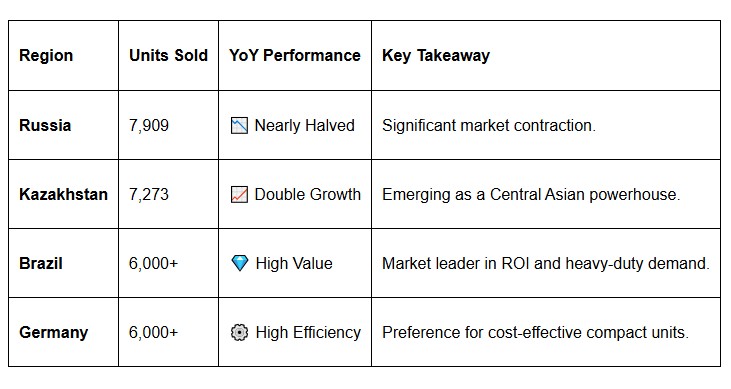
Why did Brazil generate nearly double the export value of Germany, despite importing similar quantities? The answer lies in the Luyu Heavy Industry model.
The Brazilian Advantage
Luyu has moved beyond simple "shipping" to "Global Serving" by establishing:
Local Warehouses: Immediate availability of stock.
Showrooms: Allowing customers to perform factory-standard inspections on-site.
After-Sales Hubs: Providing 24/7 spare parts and technical support.
"Luyu's physical presence in Brazil has bridged the trust gap," notes a regional trade expert. By allowing customers to 'touch and feel' the equipment before purchase, Luyu has successfully pushed higher-tonnage, high-value models into the mining and agricultural sectors.
4. Geopolitical Reordering: Winners and Losers

5. Top Revenue Contributors (Million USD)
The top 20 nations accounted for $2.3 Billion (59.1%) of total export value.
RU Russia: $270M
US USA: $260M
BR Brazil: >$150M
KZ Kazakhstan: >$120M
Others: UAE, Saudi Arabia, Australia, and Indonesia all crossed the $100M threshold.
6. Future Outlook: Beyond the Machine
As we move into 2026, the success of players like Luyu Heavy Industry proves that localization is the new globalization. For Chinese loader brands, the next frontier isn't just about manufacturing—it's about building local ecosystems, warehouses, and trust.
Friday, January 23, 2026
Balancing Economic Benefits and Environmental Protection: The Sustainable Development Path of a Tanzanian Gold Mine Project
In the global wave of mining transformation towards "green, low-carbon, and sustainable development," mining projects no longer solely pursue economic benefits but also consider ecological protection and social responsibility, achieving synergistic development among the three. The 1200 tons/day gold processing plant in Tanzania, as a benchmark project for green mining in the region, achieves high recovery rates through the use of a full-sludge cyanidation process while effectively controlling pollutant emissions and promoting resource recycling through a series of environmental protection technologies and management measures, thus forging a sustainable mining development path suitable for local African conditions.
The safe management of cyanide is the core of environmental protection work in the full-sludge cyanidation process. This project addresses the highly toxic nature of cyanide by establishing a comprehensive safety management system: At the process level, the pH of the slurry is precisely adjusted to above 10.5 to suppress the generation of toxic gases from cyanide hydrolysis. Simultaneously, a highly efficient cyanide recovery system is employed to recycle unreacted cyanide, reducing cyanide consumption by over 30%. At the wastewater treatment level, a cyanide-crushing treatment workshop has been constructed, using bleaching powder oxidation to deeply treat cyanide-containing wastewater. The treated wastewater has a cyanide concentration below 0.5 mg/L, meeting local environmental emission standards and allowing it to be recycled for grinding, leaching, and other processes. This increases the water resource reuse rate to over 85%, effectively alleviating Tanzania's water shortage problem.
The compliant disposal and comprehensive utilization of tailings are another crucial aspect of the project's sustainable development. This project employs a "concentration-filtration-dry stacking" tailings treatment process. A high-efficiency filter press reduces the moisture content of the tailings to below 20%, forming a dry stack filter cake. This not only reduces the land area occupied by the tailings dam but also lowers the risk of soil and groundwater pollution from tailings leakage. Simultaneously, the project team conducted a systematic property analysis of the tailings, discovering that in addition to trace amounts of gold, the tailings also contain certain amounts of valuable elements such as sulfur and iron, possessing comprehensive recovery value. Based on this, the project has reserved interfaces for tailings reprocessing, allowing for the future recovery of valuable elements through bioleaching technology, turning waste into treasure and improving resource utilization. Furthermore, the project is also carrying out vegetation restoration work around the tailings dam, planting local native plants to reduce soil erosion and gradually achieve mine ecological restoration.
Optimizing energy consumption is a crucial measure in the project's green transformation. In the grinding and classification stage, a centrally aerated riser mixing system is used, reducing power consumption by 70% compared to traditional mechanical mixing tanks. In crushing and screening stages, high-efficiency energy-saving equipment is selected, resulting in an overall unit energy consumption reduction of 18% compared to similar gold mine concentrators. Meanwhile, the project fully utilizes Tanzania's abundant solar energy resources, planning and constructing a distributed photovoltaic power generation system. Once operational, this system will meet over 15% of the project's electricity needs, further reducing fossil fuel consumption and carbon emissions.
Sustainable development is not only reflected in the application of environmental protection technologies but also in harmonious coexistence with the local community. During construction and operation, the project prioritizes employing local staff, providing them with professional skills training and stable salaries and benefits, thus boosting local employment. Simultaneously, it invests in improving infrastructure in surrounding communities, constructing roads and water supply facilities, enhancing the quality of life for local residents. Furthermore, the project strictly adheres to Tanzanian mining regulations and environmental policies, regularly conducting environmental monitoring and public disclosure, and proactively accepting supervision from the local government and community, establishing a responsible mining company image.
The experience of the 1200 tons/day gold mine beneficiation plant in Tanzania demonstrates that mining projects can achieve a balance of economic, ecological, and social benefits through process optimization, the application of environmental technologies, and community collaboration. Against the backdrop of the global green mining transformation, this project's sustainable development experience provides valuable lessons for similar gold mining projects in Africa and globally, driving the mining industry towards greater efficiency, environmental friendliness, and social responsibility.
EPC+M+O Model Empowers African Mining: A Successful Paradigm of the Tanzania Gold Mine Project
Amidst the rapid development of the African mining market, innovative project delivery models have become a crucial indicator of a company's core competitiveness. The 1200-ton/day gold concentrator in Tanzania adopted an EPC+M+O (Engineering, Design, Procurement, Construction + Operation Management + Production Maintenance) full lifecycle service model. Leveraging its integrated service capabilities, the project achieved efficient progress from planning to implementation, ensuring not only the successful implementation of processes and achieving production targets but also reducing operational risks for the mine owner. This serves as a successful example of the EPC+M+O model's application in African mining.
Traditional mining projects often employ segmented contracting models, with design, construction, and operation handled by different entities. This can easily lead to problems such as a disconnect between process design and actual operation, insufficient equipment compatibility, and delayed operation and maintenance response, severely impacting project progress and production capacity. The EPC+M+O model, by integrating resources across the entire industry chain, achieves seamless integration of "design-construction-operation," with a single entity responsible for the entire project, fundamentally solving the pain points of segmented contracting. In the Tanzania gold mine project, the service team started with preliminary geological exploration and ore analysis, tailoring a complete cyanidation process solution based on local resource conditions and environmental requirements. They then independently procured suitable equipment, carried out on-site construction and installation, commissioning and optimization, and ultimately took responsibility for long-term operation and management, forming a "one-stop" service loop.
During project implementation, the value of the EPC+M+O model was fully demonstrated in multiple dimensions. In terms of cost control, the service team effectively reduced equipment investment and construction costs by optimizing process design and centrally procuring equipment. Simultaneously, through refined operation and management, they optimized reagent consumption and reduced electricity and labor costs, resulting in a unit processing cost reduction of over 15% compared to similar segmented contracting projects. Regarding schedule control, the coordinated advancement of design and construction avoided delays caused by design changes. The project reached its target production level in just ten months from start-up, 20% shorter than the industry average, creating conditions for the mine owner to quickly achieve profitability. In terms of risk management, the service team, leveraging its extensive experience in African projects, proactively anticipates risks related to local policies and regulations, supply chains, and labor, developing targeted response plans to ensure the project's stable progress in complex environments.
Operations management and maintenance services, as a core component of the EPC+M+O model, directly determine the project's long-term profitability. In the Tanzania gold mine project, the service team established an intelligent operations monitoring system to monitor and dynamically adjust key parameters in each stage, including crushing, grinding, leaching, and desorption/electrolysis, ensuring that core indicators such as leaching rate and recovery rate remain stable at high levels. Simultaneously, a professional operations and maintenance team was assembled to regularly inspect and maintain equipment, promptly addressing equipment malfunctions, maintaining an equipment uptime rate above 95%, far exceeding the industry average. Furthermore, the service team provided professional skills training to local employees, addressing the project's manpower needs while cultivating mining technical talent for the local community, achieving a win-win situation for both the project and the local community.
With the increasing demand for efficient, stable, and environmentally friendly projects in the African mining industry, the EPC+M+O model is becoming the mainstream trend in the industry. The success of the 1200-ton/day gold processing plant in Tanzania demonstrates the unique advantages of this model in resource integration, efficiency optimization, and risk management, providing a referable cooperation paradigm for more mining companies entering the African market. In the future, with the integration of intelligent and green technologies, the EPC+M+O model will be further upgraded, injecting new momentum into the high-quality development of the African mining industry.
-
High-purity quartz (HPQ) is a crucial material in various high-tech industries, including electronics, optics, and photovoltaics. The purifi...
-
Gold heap leaching has evolved into one of the most efficient, flexible, and environmentally adaptive methods of gold extraction. Since its ...
-
Mini-excavators with CE (Conformité Européenne) certification and Euro V emission standards are typically designed to meet the safet...